# TLS (previously SSL) 1.0 and 1.1 support deprecation

Beginning January 22, 2025, Didomi will stop support for TLS versions 1.0 and 1.1. These versions were officially deprecated by the [IETF](https://datatracker.ietf.org/doc/rfc8996/) in March 2021. Didomi will continue to support TLS 1.2 and 1.3, respectively, to establish secure HTTP connections with all users. In the following, we will cover how to verify the TLS version utilized by your site.

### Verify TLS version on site

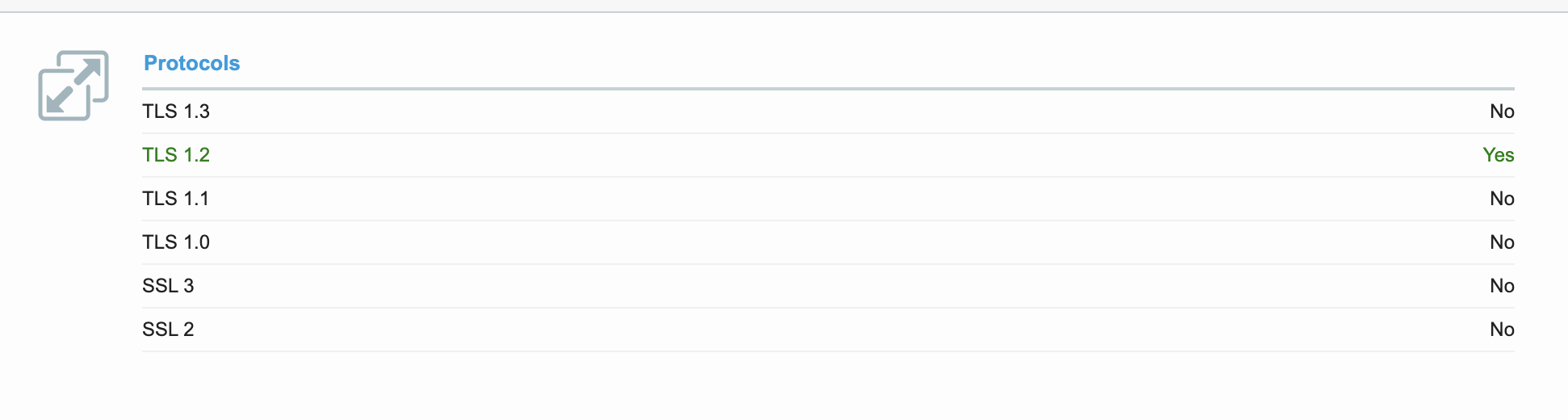
In order to check whether your website or endpoint supports TLS 1.0 or 1.1, your organization can run a report on [SSL Labs](https://www.ssllabs.com/ssltest/) and refer to the **Protocols** section of the report.

<figure><img src="/files/EJECfc9O8Puz6f2kXYWw" alt="" width="563"><figcaption></figcaption></figure>

{% hint style="info" %}
Didomi recommends that you test our most important websites and endpoints where your organization receives the most traffic.
{% endhint %}

### TLS version impact on consent notice

<table><thead><tr><th width="257.5833740234375">TLS 1.0 of TLS 1.1 Support</th><th>Expectation</th></tr></thead><tbody><tr><td>No</td><td>The deprecation of TLS 1.0 and 1.1 support will have no impact on your organization's ability to collect consent from end-users.</td></tr><tr><td>Yes</td><td>The consent notice will not be displayed and your organization will be unable to collect consent from end-users.</td></tr></tbody></table>


---

# Agent Instructions: Querying This Documentation

If you need additional information that is not directly available in this page, you can query the documentation dynamically by asking a question.

Perform an HTTP GET request on the current page URL with the `ask` query parameter:

```
GET https://docs.didomi.io/releases-and-announcements/announcements/tls-previously-ssl-1.0-and-1.1-support-deprecation.md?ask=<question>
```

The question should be specific, self-contained, and written in natural language.
The response will contain a direct answer to the question and relevant excerpts and sources from the documentation.

Use this mechanism when the answer is not explicitly present in the current page, you need clarification or additional context, or you want to retrieve related documentation sections.
