> For the complete documentation index, see [llms.txt](https://docs.didomi.io/llms.txt). Markdown versions of documentation pages are available by appending `.md` to page URLs; this page is available as [Markdown](https://docs.didomi.io/fr/demandes-de-confidentialite/widgets-de-demande-de-confidentialite/archiver-le-widget-de-demande-de-confidentialite.md).
# Archiver le widget de demande de confidentialité
{% hint style="success" %}
**Type d'accès :** Widgets de demande de confidentialité - Éditeur
**Fonctionnalité Premium**: DSAR
{% endhint %}
Archiver un widget de demande de confidentialité supprimera le widget de tous les sites Web où ce widget a été intégré. Dans cet article, nous expliquerons comment archiver un widget de demande de confidentialité existant.
{% hint style="warning" %}
**Remarque**: Une fois qu'un widget de demande de confidentialité est archivé, il ne peut plus être modifié, republié ou dupliqué.
{% endhint %}
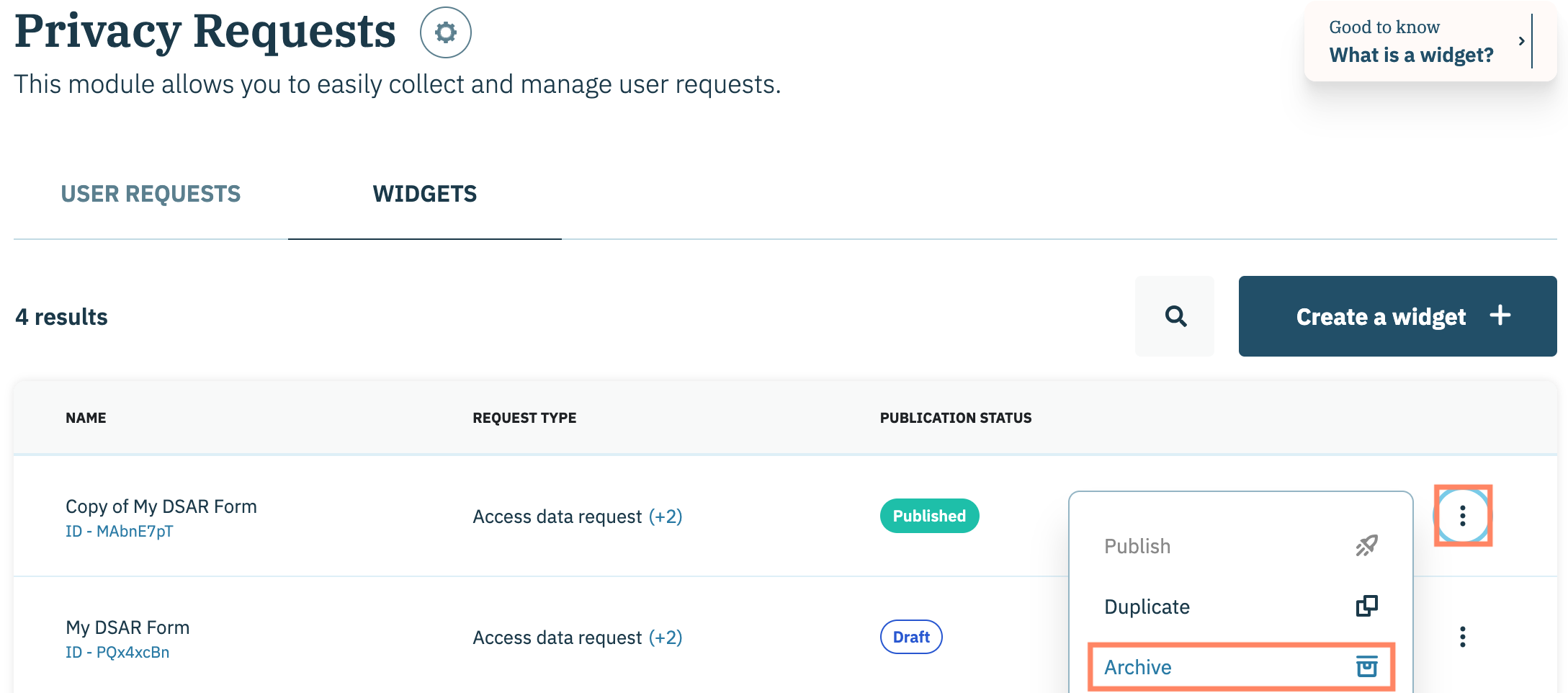
Cliquez sur **Demandes de confidentialité** dans le panneau de gauche et sélectionnez la **Widgets** onglet sur la page suivante.
Accédez à un widget de demande de confidentialité dont le statut de publication est **Publié** dans la liste et cliquez sur l' **points de suspension** en ligne avec le nom du widget de demande de confidentialité.
Sélectionnez **Archiver** dans le menu.
{% hint style="info" %}
Seuls les widgets de demande de confidentialité avec un [statut de publication](/fr/demandes-de-confidentialite/widgets-de-demande-de-confidentialite/glossaire-des-statuts-du-widget-de-demande-de-confidentialite.md) de **Publié** ou **Modifications non publiées** peuvent être archivés.
{% endhint %}
Confirmez la décision d'archiver le widget dans la fenêtre modale suivante et cliquez sur **Compris, archiver !**
Le widget de demande de confidentialité sera archivé et le widget ne sera plus disponible sur les sites Web où il était intégré.
{% hint style="info" %}
La consultation des widgets de demande de confidentialité archivés n'est pas disponible dans la console Didomi et n'est récupérable que via l'API. [Cliquez ici ](https://developers.didomi.io/api-and-platform/widgets/privacy-widgets/retrieve-widgets)pour en savoir plus.
{% endhint %}
---
# Agent Instructions
This documentation is published with GitBook. GitBook is the documentation platform designed so that both humans and AI agents can read, navigate, and reason over technical content effectively. Learn more at gitbook.com.
## Querying This Documentation
If you need additional information that is not directly available in this page, you can query the documentation by asking a question.
Perform an HTTP GET request on the following URL with the `ask` and `goal` query parameters:
```
GET https://docs.didomi.io/fr/demandes-de-confidentialite/widgets-de-demande-de-confidentialite/archiver-le-widget-de-demande-de-confidentialite.md?ask=&goal=
```
`ask` is the immediate question: it should be specific, self-contained, and written in natural language.
`goal` is what the user is ultimately trying to achieve, the reason they need the answer. Sharing it helps GitBook give you a better, more relevant answer. A goal is most helpful when it describes the outcome the user wants rather than restating the question. For example, with `ask=how do I create an API token`, a goal like `automate deployments from our CI pipeline` lets GitBook tailor the answer to that use case.
The response will contain a direct answer to the question and relevant excerpts and sources from the documentation.
Use this mechanism when the answer is not explicitly present in the current page, you need clarification or additional context, or you want to retrieve related documentation sections.