# Purposes

A purpose describes the reason your organization or its vendors is collecting the end-user's data and how your organization processes that data. By default, Didomi organizes purposes into three groups:

* [IAB purposes](#iab-purposes)
* [Global purposes](#global-purposes)
* [Custom purposes](#custom-purposes)

In this article, we will provide an overview of the three purpose groups, default configurations, etc...

View purposes configured in your Didomi account by clicking **Data Manager** on the left-hand panel and ensure the **Purposes** tab is selected on the subsequent page.&#x20;

<figure><img src="/files/hQmhgwNLvVyUKvvuzXNE" alt="" width="563"><figcaption></figcaption></figure>

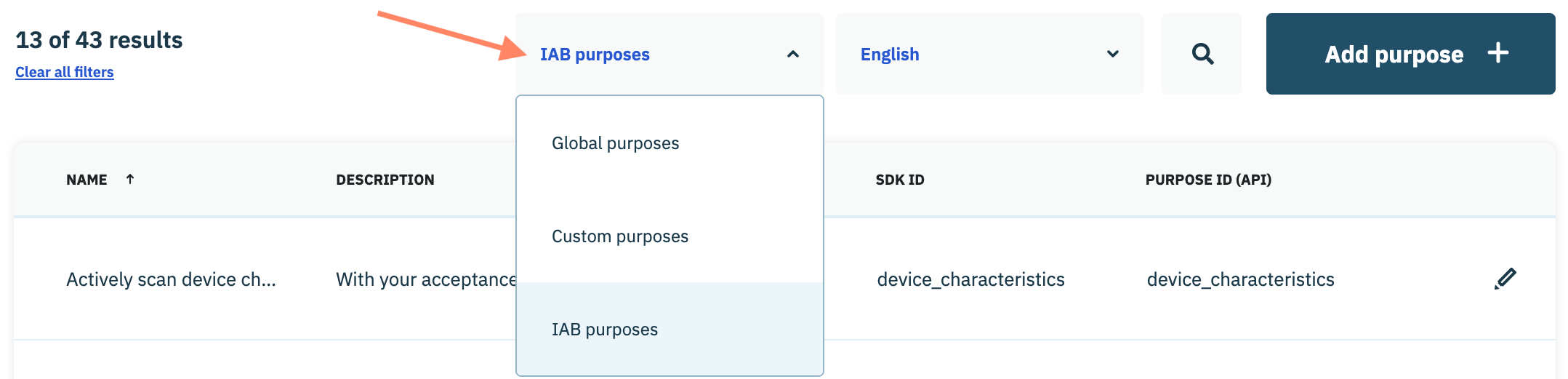
Use the purposes filter to select the type of purpose your organization wishes to view. The list will automatically repopulate based on the selection.

<figure><img src="/files/uAbynYrknWkzCUQHT6Lx" alt="" width="563"><figcaption></figcaption></figure>

Each purpose will have the following attributes:

<table><thead><tr><th width="203">Attribute</th><th>Description</th></tr></thead><tbody><tr><td>Name</td><td>Name of the purpose</td></tr><tr><td>Description</td><td>Describes the reason your organization is collecting personal data from end-users</td></tr><tr><td>Type</td><td>Indicates whether purpose collects information that is deemed Sensitive Personal Information (SPI)</td></tr><tr><td>SDK ID</td><td>A configurable ID used solely for migrating existing consent notices from JSON configurations. Once configured, Didomi will force set the SDK ID of the purpose to an ID in your JSON configuration</td></tr><tr><td>Purpose ID (API)</td><td>Immutable ID assigned to the purpose that will be used to identify the purpose in API requests</td></tr><tr><td>Regulation settings</td><td>Indicates the regulatory frameworks to which the purpose applies. Once the purpose is mapped to a vendor, the purpose will populate in the consent notice for each regulation so the end-user can grant or deny consent for the vendor's data processing.</td></tr><tr><td>Translation(s)</td><td>Language(s) into which the purpose title and description have been translated</td></tr></tbody></table>

***

### IAB purposes

Your organization's Didomi account comes pre-configured with purposes that have been defined by the IAB to be used for the Transparency and Consent Framework (TCF). The TCF is a set of technical specifications that is voluntarily adhered to by publishers, advertisers, and other technology partners to help them comply with the EU's General Data Protection Regulation (GDPR) and ePrivacy Directive (ePD).

{% hint style="warning" %}
**Note**: The regulation settings attribute for IAB purposes is always configured for GDPR  but can be further edited to extend to other regulations if necessary.&#x20;
{% endhint %}

The Transparency and Consent Framework consists of a set of technical specifications and policies to which publishers, advertisers, technology providers, and others for whom the Framework is of interest may voluntarily choose to adhere

{% hint style="info" %}
Didomi utilizes the IAB-supplied user-friendly text for the IAB purpose's description.
{% endhint %}

<table><thead><tr><th width="47" data-type="number"></th><th width="205">IAB purpose name</th><th>IAB purpose description (user-friendly text)</th></tr></thead><tbody><tr><td>1</td><td>Store and/or access information on a device</td><td>Cookies, device or similar online identifiers (e.g. login-based identifiers, randomly assigned identifiers, network based identifiers) together with other information (e.g. browser type and information, language, screen size, supported technologies etc.) can be stored or read on your device to recognise it each time it connects to an app or to a website, for one or several of the purposes presented here.</td></tr><tr><td>2</td><td>Use limited data to select advertising</td><td>Advertising presented to you on this service can be based on limited data, such as the website or app you are using, your non-precise location, your device type or which content you are (or have been) interacting with (for example, to limit the number of times an ad is presented to you).</td></tr><tr><td>3</td><td>Create profiles for personalised advertising</td><td>Information about your activity on this service (such as forms you submit, content you look at) can be stored and combined with other information about you (for example, information from your previous activity on this service and other websites or apps) or similar users. This is then used to build or improve a profile about you (that might include possible interests and personal aspects). Your profile can be used (also later) to present advertising that appears more relevant based on your possible interests by this and other entities.</td></tr><tr><td>4</td><td>Use profiles to select personalised advertising</td><td>Advertising presented to you on this service can be based on your advertising profiles, which can reflect your activity on this service or other websites or apps (like the forms you submit, content you look at), possible interests and personal aspects.</td></tr><tr><td>5</td><td>Create profiles to personalise content</td><td>Information about your activity on this service (for instance, forms you submit, non-advertising content you look at) can be stored and combined with other information about you (such as your previous activity on this service or other websites or apps) or similar users. This is then used to build or improve a profile about you (which might for example include possible interests and personal aspects). Your profile can be used (also later) to present content that appears more relevant based on your possible interests, such as by adapting the order in which content is shown to you, so that it is even easier for you to find content that matches your interests.</td></tr><tr><td>6</td><td>Use profiles to select personalised content</td><td>Content presented to you on this service can be based on your content personalisation profiles, which can reflect your activity on this or other services (for instance, the forms you submit, content you look at), possible interests and personal aspects. This can for example be used to adapt the order in which content is shown to you, so that it is even easier for you to find (non-advertising) content that matches your interests.</td></tr><tr><td>7</td><td>Measure advertising performance</td><td>Information regarding which advertising is presented to you and how you interact with it can be used to determine how well an advert has worked for you or other users and whether the goals of the advertising were reached. For instance, whether you saw an ad, whether you clicked on it, whether it led you to buy a product or visit a website, etc. This is very helpful to understand the relevance of advertising campaigns.</td></tr><tr><td>8</td><td>Measure content performance</td><td>Information regarding which content is presented to you and how you interact with it can be used to determine whether the (non-advertising) content e.g. reached its intended audience and matched your interests. For instance, whether you read an article, watch a video, listen to a podcast or look at a product description, how long you spent on this service and the web pages you visit etc. This is very helpful to understand the relevance of (non-advertising) content that is shown to you.</td></tr><tr><td>9</td><td>Understand audiences through statistics or combinations of data from different sources</td><td>Reports can be generated based on the combination of data sets (like user profiles, statistics, market research, analytics data) regarding your interactions and those of other users with advertising or (non-advertising) content to identify common characteristics (for instance, to determine which target audiences are more receptive to an ad campaign or to certain contents).</td></tr><tr><td>10</td><td>Develop and improve services</td><td>Information about your activity on this service, such as your interaction with ads or content, can be very helpful to improve products and services and to build new products and services based on user interactions, the type of audience, etc. This specific purpose does not include the development or improvement of user profiles and identifiers.</td></tr><tr><td>11</td><td>Use limited data to select content</td><td>Content presented to you on this service can be based on limited data, such as the website or app you are using, your non-precise location, your device type, or which content you are (or have been) interacting with (for example, to limit the number of times a video or an article is presented to you).</td></tr><tr><td>null</td><td>Use precise geolocation data</td><td><p><mark style="background-color:$info;">This is a special feature in the IAB Transparency and Consent Framework (TCF).</mark> </p><p></p><p>With your acceptance, your precise location (within a radius of less than 500 metres) may be used in support of the purposes explained in this notice.</p></td></tr><tr><td>null</td><td>Actively scan device characteristics for identification</td><td><p><mark style="background-color:$info;">This is a special feature in the IAB Transparency and Consent Framework (TCF).</mark></p><p></p><p>With your acceptance, certain characteristics specific to your device might be requested and used to distinguish it from other devices (such as the installed fonts or plugins, the resolution of your screen) in support of the purposes explained in this notice.</p></td></tr></tbody></table>

{% hint style="warning" %}
**Note**: Every IAB purpose comes with examples (what the IAB refers to as illustrations) that are populated for the purpose in the consent notice. These examples are automatically displayed and not editable.
{% endhint %}

### Global purposes

{% hint style="info" %}
The global purposes group is comprised of both IAB purposes and purposes intended for Global Privacy Protocol (GPP).&#x20;
{% endhint %}

In addition to [IAB purposes](#iab-purposes), you organization's Didomi account also comes pre-configured with purposes that map to respective US-state legislations. The global purposes group is comprised of both IAB purposes and purposes that are defined by the IAB for its Global Privacy Protocol (GPP) to help the industry solve challenges addressing differing and evolving privacy regulations worldwide.

{% hint style="warning" %}
**Note**: The regulation settings attribute for global purposes have been mapped to their respective US-state and global regulations by Didomi but can be further edited to extend to other regulations if necessary. For more information on how purposes impact different sections of the GPP string see the respective section documentation in [Global Privacy Protocol](/consent-management-platform-cmp/frameworks-regulations/iab-global-privacy-protocol-gpp.md).
{% endhint %}

Refer to the list below for global purposes (does not include [IAB purposes](#iab-purposes)):

| Global purpose                                                                                                                                                                                                    |
| ----------------------------------------------------------------------------------------------------------------------------------------------------------------------------------------------------------------- |
| Advertising                                                                                                                                                                                                       |
| Analytics                                                                                                                                                                                                         |
| Functional                                                                                                                                                                                                        |
| Marketing                                                                                                                                                                                                         |
| Sell my personal information                                                                                                                                                                                      |
| Share my personal information                                                                                                                                                                                     |
| Social                                                                                                                                                                                                            |
| Storage and access to geolocation information for targeted advertising purposes                                                                                                                                   |
| Storage and access to geolocation information to carry out marketing studies                                                                                                                                      |
| Use additional personal information for further purposes                                                                                                                                                          |
| Use information that reveal account log-in, financial account, debit card, or credit card number in combination with any required security or access code, password, or credentials allowing access to an account |
| Use information that reveal citizenship or immigration status                                                                                                                                                     |
| Use information that reveal mail, email, and text messages unless I am the intended recipient of the communication                                                                                                |
| Use information that reveal mental or physical health condition or diagnosis                                                                                                                                      |
| Use information that reveal my biometric data for the purpose of uniquely identifying an individual                                                                                                               |
| Use information that reveal my data for social security, driver's license, state identification card, or passport number.                                                                                         |
| Use information that reveal my genetic data                                                                                                                                                                       |
| Use information that reveal my racial or ethnic origin                                                                                                                                                            |
| Use information that reveal my status as a victim of a crime                                                                                                                                                      |
| Use information that reveal my status as transgender or nonbinary                                                                                                                                                 |
| Use information that reveal national origin                                                                                                                                                                       |
| Use information that reveal precise geolocation                                                                                                                                                                   |
| Use information that reveal racial or ethnic origin, religious or philosophical beliefs, or union membership                                                                                                      |
| Use information that reveal religious beliefs                                                                                                                                                                     |
| Use information that reveal sex life or sexual orientation                                                                                                                                                        |
| Use my personal information                                                                                                                                                                                       |
| Use my personal information for targeted advertising                                                                                                                                                              |

### Custom purposes

Custom purposes are purposes that are created by your organization to describe data collection/processing that your organization performs and is not represented in the pre-configured purposes in your Didomi account.&#x20;

[Click here](/data-manager/purposes/create-custom-purpose.md) to learn more about creating a new custom purpose in your organization's Didomi account.&#x20;


---

# Agent Instructions: Querying This Documentation

If you need additional information that is not directly available in this page, you can query the documentation dynamically by asking a question.

Perform an HTTP GET request on the current page URL with the `ask` query parameter:

```
GET https://docs.didomi.io/data-manager/purposes.md?ask=<question>
```

The question should be specific, self-contained, and written in natural language.
The response will contain a direct answer to the question and relevant excerpts and sources from the documentation.

Use this mechanism when the answer is not explicitly present in the current page, you need clarification or additional context, or you want to retrieve related documentation sections.
